
Useful information
Τι είναι ορθοδοντική και ποιος την ασκεί;
Orthodontics is the specialty of dentistry, which deals with the arrangement of teeth in dental arches and the guidance of the jaws in harmonious positions between them, with the aim of restoring the proper functioning of the mouth and the aesthetics of the face.
It is one of the most recognized specialties in dentistry compared to all similar specialties in medicine. For the practice of orthodontics, in addition to the knowledge of the general dentist, special knowledge is required, which is acquired after the degree of the School of Dentistry in integrated postgraduate programs of domestic or foreign universities.
The title of orthodontist is awarded by the Ministry of Health and Welfare after an examination. Thus, only those who have the relevant certificate of the Ministry are entitled to bear the title of orthodontist.
The orthodontist, i.e. the now qualified dentist, deals exclusively with the subject of orthodontics.
Given that the orthodontic specialty has recently been recognized in Greece and the number of qualified orthodontists is limited, it is recommended that those interested in orthodontic treatment should check beforehand, through the local Dental Associations, whether the dentist to whom they have been referred is an orthodontic specialist.
Πότε είναι απαραίτητη η ορθοδοντική θεραπεία;
Orthodontic treatment is considered necessary in cases with dental, skeletal and functional abnormalities of the mouth. The orthodontist is required to achieve one or more of the following objectives:
- Proper mouth function (chewing, speech)
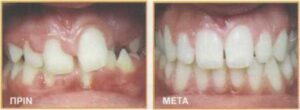
- Facilitate oral hygiene, resulting in fewer future problems with teeth and gums and a longer period of time in the mouth. The difference in the condition of the gums is obvious in the following pictures before and after the treatment.
- Facilitation of the general dentist and other specialties as well as better prognosis when performing dental work (fillings, bridges, dentures, gum and periodontal treatments) with the arrangement of teeth and functional restoration of the mouth.
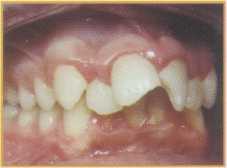
- Reducing the chance of tooth fractures especially when they protrude from the lips, especially in young people, as in the case in the picture.
- Reducing the likelihood of problems in the temporomandibular joint, the area where the lower jaw connects to the skull.
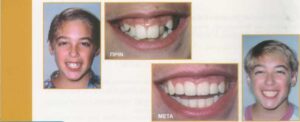
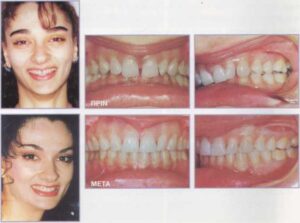
- A beautiful smile and a more pleasant face resulting in a boost to the person’s self-confidence, as shown in the following incident.
Βασικά προβλήματα, που αντιμετωπίζει ο ορθοδοντικός
Basic problems that the orthodontist faces
First type
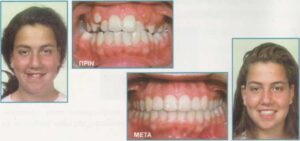
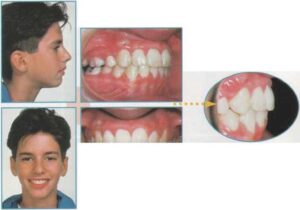
There are three main types of problems. The first type is dental problems, where the teeth for various reasons do not have correct positions in their bone base, resulting in crowded, spaced or crooked teeth. Usually these problems are not obvious when the mouth is closed, as seen in the following case.
Second type
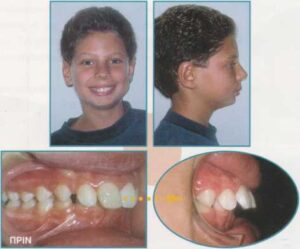
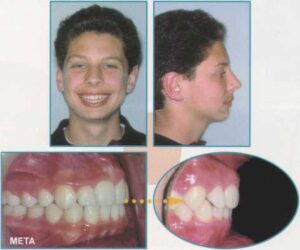
The second type is skeletal problems, where the jaws have not grown harmoniously together, affecting the function of the mouth and facial aesthetics. The aim of orthodontic treatment is to improve the position of the teeth and the harmony of the face.
Third type
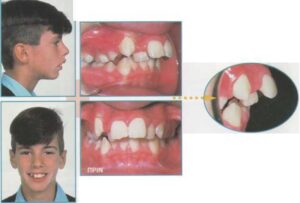
Finally, in the third type, the patient presents a combination of dental and skeletal problems, which affect not only the oral area but also the facial appearance.
The improvement with the help of orthodontic treatment is obvious.
Ποιες είναι οι αιτίες των ορθοδοντικών προβλημάτων;
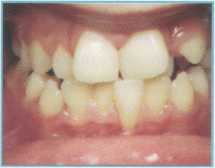
Orthodontic problems may be due to hereditary or environmental factors or a combination of the above. The size of teeth and jaws and the relationships between them are characteristics that are inherited from parents to children.
A hereditary factor can be considered if the child has inherited large teeth from the father and small jaws from the mother, resulting in teeth that do not fit and show severe crowding.
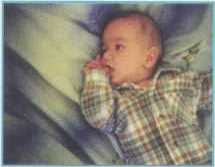
Environmental factors are various abnormal habits, such as oral breathing, sucking the finger or tongue, biting the nails or foreign objects (pencils), resulting in the teeth migrating and disturbing the harmonious relationship of the jaws with a direct impact on facial aesthetics.
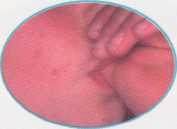
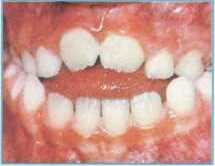
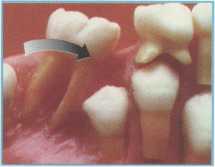
Another condition that often causes orthodontic problems is the premature loss of children’s teeth due to caries. This is because, due to the movement of the adjacent teeth, the space that the children’s teeth have to maintain until the permanent teeth come in is lost. So when the time comes for the permanent ones to come up, there is not enough space, resulting in overcrowding or other related problems.
Πότε πρέπει να αρχίσει μια ορθοδοντική θεραπεία;
THE SOONER THE BETTER
Guided by the fact that prevention of problems is essential in every medical and dental specialty, we would recommend that the first visit to the orthodontist should be at the age of 6-7 years. Only then will the orthodontist determine whether or not there is a problem, its severity and the appropriate time to start treatment. In general, orthodontics has a preventive, suppressive and restorative character.
Preventive orthodontics, which is applied at an early age, addresses problems such as premature loss of baby teeth, prolonged finger sucking and tongue advancement.
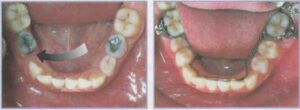
Early placement of space maintainers in cases of early loss of children’s teeth prevents some of the future crowding problems, as can be seen in the photos below.
In cases of finger sucking and tongue advancement, it is possible with proper guidance of parents and child to discontinue these habits without the need for orthodontic appliances.
In the following case, the improvement in the position of the teeth after stopping the tongue advancement is evident.
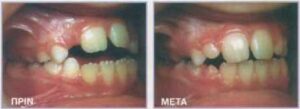
Restorative orthodontics usually begins at the age of 7-9 years. Its purpose is to stop the development of skeletal jaw malformations, facial asymmetry or dental problems which, without timely treatment, will worsen. The restoration of symmetry in the face and mouth after suppressive intervention is evident in the following case.
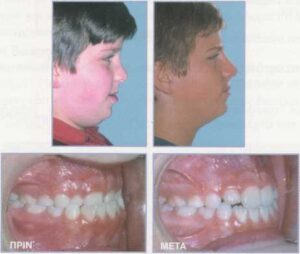
Finally, restorative orthodontics aims to treat existing problems in children or adults and its initiation is decided by the orthodontist, depending on the type of problem and the stage of the child’s dental and skeletal development.
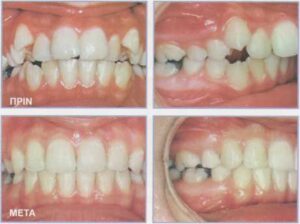
Advantages of starting treatment early !!!
- Greater likelihood of avoiding extraction of permanent teeth.
- Better control of skeletal problems since before puberty the orthodontist can check and influence skeletal growth.
- Better tissue response to treatment.
- Greater degree of adaptation of young patients to the mechanisms and better cooperation.
- Practically easier treatment, due to fewer obligations of primary school children than those of secondary school children.
- Younger children are not ashamed and generally do not have the inhibitions of older children.
- When treatment begins early, by the time puberty is almost over, teenagers have increased self-confidence due to the better appearance of the mouth and face in general.
- Adult patients, in whom the skeleton is now formed, are more often treated with extractions of permanent teeth, or when there are skeletal problems some surgery may be required.
Τι είδους ορθοδοντικοί μηχανισμοί υπάρχουν;
The appliances used during orthodontic treatment can be mobile appliances, when the child can remove them from the mouth on his/her own, or fixed appliances, when they are left fixed to the teeth during treatment and can only be removed by the orthodontist. A minor discomfort is considered normal and is expected during the first 24 hours after the placement of the new orthodontic appliances.
Enlargement mechanisms:
They are mechanisms used to change the shape of dental arches. They include mobile enlargement plates that must be in the mouth day and night and stationary enlargement mechanisms that are permanently attached to the teeth.
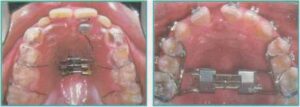
Operating machinery:
They are mobile or stationary mechanisms used to correct skeletal problems in case the orthodontist seeks to guide, stimulate or even inhibit the growth of the jaws. They are indicated for young children, but especially in pre-adolescence and adolescence. Mobile appliances are used at night and some hours of the day, while fixed appliances, because they are fixed to the teeth, cannot be removed by the child.
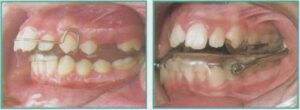
The advantage of mobile devices over stationary ones is that they are easier to clean and can be removed for more comfortable chewing. But the fact that they are removed at will is a serious disadvantage in uncooperative children.
Outside oral appliances:
These are supported by elastic straps on the neck or head and are used either in orthodontic problems, providing the teeth with the missing space, or in skeletal problems by encouraging or inhibiting the growth of the jaws.
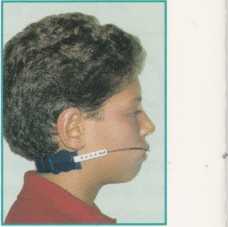
Fixed mechanisms:
Elastic bushings, elastic chains or special springs, which are placed in combination with the arches connecting the metal or ceramic hooks, cause the teeth to move with precision in the desired direction. They are used at any age and are absolutely indicated whenever precision movement of some or all teeth is necessary.
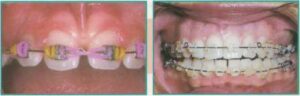
A prerequisite for their use is perfect oral hygiene, which, if not present, can threaten the health of teeth and gums.
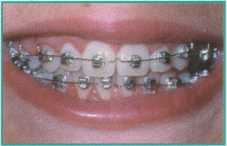
Containment mechanisms:
After the removal of the movable mechanisms, it is necessary to maintain the result for a period of time, which is determined by the orthodontist on a case-by-case basis. This is done with mobile or stationary restraint mechanisms. The patient’s consistency in this phase is crucial, because it ensures the treatment from possible relapses.
Βλαβερές συνήθειες
Various habits of children are often the causes of abnormalities in the development of the teeth and mouth. Such habits include mouth breathing (often associated with oversized tonsils, adenoidal sprouts, chronic asthma, allergic conditions), teeth grinding, tongue pressure, biting the lower lip, nails or foreign objects (pencils, erasers, etc.), one-sided chewing, finger sucking, etc.

Breastfeeding of the finger in young children usually stops at 2-3 years of age, when some slight damage is self-corrected without further intervention. A child who continues after this age or even in school years to breastfeed his or her finger may be hiding some anxiety and insecurity, which may be due to a younger sibling, a long absence of the parents from home, or finally a change of school or home.
In these cases, support, affection, friendly dialogue is the best help to deal with the problem at its root. In persistent situations, the orthodontist can support the parents’ efforts with the appropriate mechanisms, so that a stable cessation of the tooth extraction is achieved. Scolding and punishment is the worst way. On the contrary, rewarding the child during his/her efforts or a token gift when he/she achieves the goal is the best approach.
Should teeth extractions be performed as part of orthodontic treatment?
During treatment, it is possible that some children’s teeth may need to be extracted when they remain in the mouth longer than normal age. The extraction or not of permanent teeth is a very serious decision, which the orthodontist has to make, when a disproportion between the size of teeth and jaws is found or when the extraction is imposed by the skeletal structure of the face.
The time of extraction and the type of teeth to be extracted are determined only by the orthodontist, who is also responsible for his decision.
Ορθοδοντική ενηλίκων Συνεργασία ορθοδοντικού με άλλες ειδικότητες
Patients with orthodontic problems that were not treated at a young age can have orthodontic treatment as adults. Often, however, the cooperation of the orthodontist with other specialties of dentistry or medicine is required (dentist, periodontist, endodontist, prosthodontist, otolaryngologist, maxillofacial surgeon, plastic surgeon, etc.). This cooperation does not necessarily concern only extensive orthodontic treatments; it is possible that orthodontic treatment may be of limited scope and duration, with an auxiliary and supporting character of other treatments (periodontics, prosthetics, etc.). The best possible functional and aesthetic result is thus achieved, as the patient benefits from the individual therapeutic possibilities provided by the combination of the various specialties.
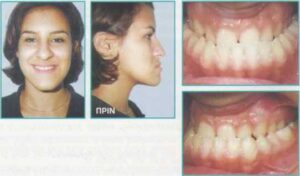
Combination of orthodontic and surgical treatment
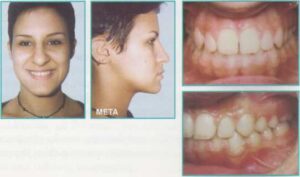
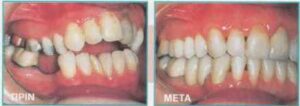
Combination of orthodontic, periodontic and prosthetic treatment
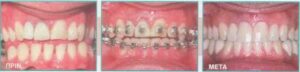
Combination of orthodontic, periodontic and prosthetic treatmentv
Ποιες είναι οι προϋποθέσεις για μια επιτυχημένη ορθοδοντική θεραπεία
The success of orthodontic treatment requires an expert orthodontist and a consistent patient.
The patient is consistent during the treatment, when he/she follows the orthodontist’s instructions for the use of orthodontic appliances, keeps his/her appointments and takes care to have impeccable oral hygiene. This means that he should brush his teeth effectively 3 times a day after basic meals, avoiding sweets, candies and chewing gum in between. This is the only way to achieve the goal of treatment in the shortest possible time.
As for the duration of treatment, it varies from a few months to a few years, depending on the nature and severity of the problem.
From the variety and complexity of both the problems and the mechanisms used, it is evident that the practice of orthodontics requires deep knowledge, great experience and skill at diagnostic and therapeutic level. Only under these conditions is it possible to recognize the true nature of the orthodontic problem and to apply the appropriate mechanisms, individually or in combination, for a correct and permanent result. This is exactly where the charm and the dangers of practicing orthodontics lie.